
What You Can Learn in Culinary School (It’s Actually Much More Than Recipes)


So, what do you really learn in culinary school? At their simplest, culinary school lessons teach students how to cook. But in reality, they teach you how to think, move and problem-solve like a professional.
Of course, that shift doesn’t happen overnight. It’s built through repetition, structure and hands-on experience — developing not just consistency, but confidence, intuition and adaptability over time.
ICE alum Pamela Vachon (Culinary, ’11) breaks down what that process actually looks like — and how those skills can translate to a working kitchen.
Pursue a culinary education with career training at ICE.
Start with the Fundamentals — and Actually Master Them
Every culinary career begins with the basics. To grow, start by laying the foundation for building core skills:
- Knife techniques
- Product identification
- Food safety and sanitation
- Kitchen organization and workflow
Even experienced cooks can benefit from revisiting fundamentals. Precision matters — and habits formed early carry through every level of cooking.
Training builds step by step, much like layering flavor in a dish.

As students progress, the focus shifts from what to cook to why it works.
Lessons expand into:
- Dry- and moist-heat cooking methods
- Soups, stocks and sauces
- Vegetable, grain and egg cookery
- Flavor development and seasoning
Students are instructed in how ingredients behave — how heat, time and technique transform them. This is also where specialized resources come into play. At ICE, students gain exposure to areas like:
- Fermentation techniques, exploring preservation, flavor development and gut-friendly cooking
- Hydroponic growing systems, connecting ingredients to their source
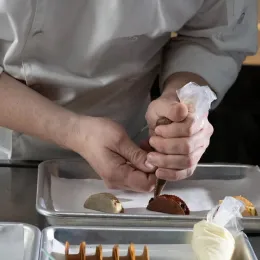
- Chocolate and pastry labs, where precision and science meet creativity
Train Across Disciplines
Well-rounded cooks aren’t limited to one area of the kitchen.
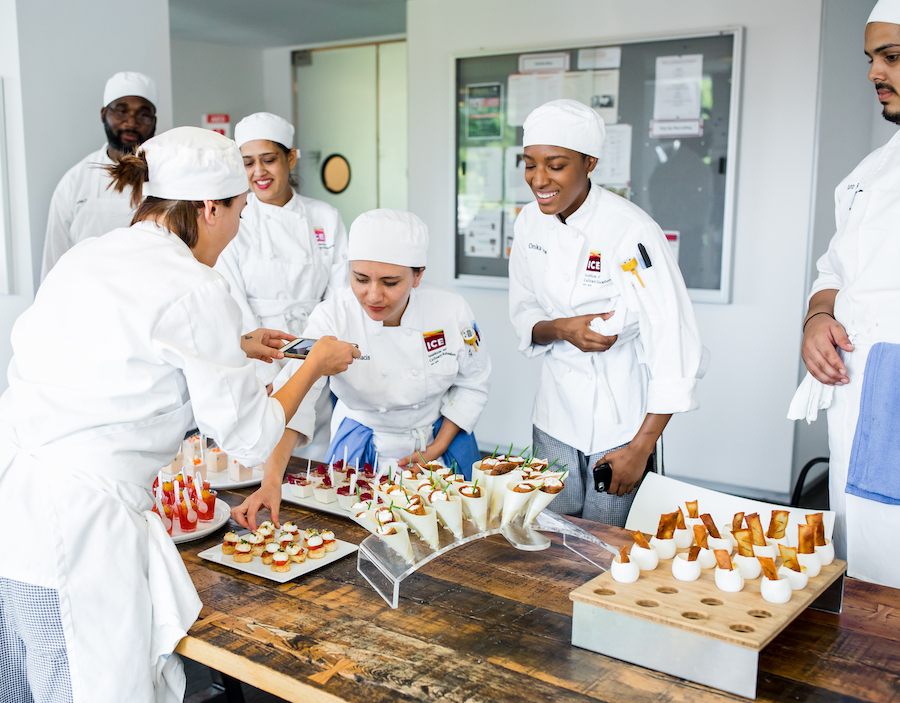
Culinary training typically includes both savory and pastry fundamentals, strengthening attention to detail, timing and technique — whether you’re baking bread, emulsifying sauces or building a composed dish.
Exercises like the “Market Basket” challenge push students to apply skills in real time, adapting and executing under pressure.
Learn to Work Like a Professional
Culinary school isn’t just about cooking — it’s about working in a professional environment. Students practice:
- Fabricating proteins
- Managing timing across multiple components
- Communicating clearly in the kitchen
- Maintaining consistency under pressure
As Chef and VP of Culinary Operations Barry Tonkinson explains:
“Between a cold pan and a finished dish are countless variables that test your skills.”
Over time, students should be able to rely less on written recipes and more on their senses — recognizing when something looks, smells or feels right.
Gain Real-World Experience Before You Graduate
A defining part of culinary training is applying acquired skills outside the classroom.
Programs culminate in an externship, where students work in professional kitchens, bakeries or food businesses — gaining firsthand experience in fast-paced environments.
With support from career services and access to industry networks in New York City and Los Angeles, students have the opportunity to step into professional settings with a clearer sense of direction.
Thinking about culinary school? ICE alumni share tips in the video below.
Develop Skills That Carry Beyond the Kitchen
While technique is essential, culinary school also aims to build skills that apply across any career path:
- Time management
- Organization
- Problem-solving
- Adaptability
These are the traits that employers look for — and the ones that help graduates stand out.
More Than Cooking — A Foundation for What Comes Next
So, what do you learn in culinary school? You can learn how to cook—but more importantly, how to think like a chef.
Through structured, hands-on training and exposure to real-world environments, students are taught useful skills to move forward — whether in restaurants, food media, entrepreneurship or beyond.
At ICE, that progression is designed to be efficient and practical, helping students build momentum and enter the industry with confidence.