Every professional kitchen has someone who holds things together, someone who acts as the glue for the larger brigade. That person is the sous chef.
In a professional kitchen, the sous chef is often the second-in-command — the person who runs the operation day to day, leads the team, holds the standard and turns the executive chef's vision into a consistently reliable reality. There are, of course, exceptions to this hierarchy; in some kitchens, an executive chef, head chef or chef de cuisine is positioned above the sous chef.
Still, the sous chef is a significant role within a culinary career path, and arriving to it generally requires time, consistency and strong technical skill. This is perhaps why those aiming to lead kitchens one day seek formal culinary education taught by expert chefs.
As James Beard Award winner, Time100 honoree and Institute of Culinary Education alum Mashama Bailey put it, “The chef-instructors are serious, the classes are serious, the deadlines are serious, and you’re expected to perform to a high standard.”
These high standards — things like working under strict time constraints, employing appropriate kitchen language, adhering to safety guidelines and preparing detailed mise en place schedules, among other rigors of a professional culinary environment — mirror those expected of sous chefs.
What Is a Sous Chef?
To start, let’s define the term. The title comes from the French sous, meaning “under” (as in, under the chef). For our purposes, sous means “subordinate to” (as the sous chef is a management position reporting directly to the executive chef). In this way, the sous chef is something of an engine for the kitchen: the one who drives service, develops the team, solves problems before they become crises, and is trusted to hold the kitchen's standards, whether the executive chef is present or not.
It’s a role that combines technical excellence with mentoring and leadership. A sous chef must coach as effectively as they execute, guiding line cooks toward better techniques and executing complex dishes under pressure.
This is perhaps why so many executive chefs consider their time as a sous so important. It helped them pivot professionally — from learner to leader. The sous chef title cues second-in-command, but it’s often the role that makes everything run smoothly.
Job Description & Responsibilities
For a sous chef, every shift is unique. Translation: you’ll rarely experience the same day twice. The scope of the role is a big part of what makes it so attractive to aspiring chefs. Among its responsibilities are:
- Overseeing daily kitchen operations and production schedules
- Supervising, training and developing line cooks and kitchen staff
- Ensuring food quality, consistency and presentation standards across every section in every service
- Assisting in menu development and recipe testing
- Managing inventory, ordering and food cost control
- Maintaining food safety and sanitation standards throughout the kitchen
- Running the service in the absence of the executive chef
- Communicating and coordinating between the kitchen and front-of-house teams
What distinguishes this role is its scope. A line cook is responsible for their station, but a sous chef is responsible for the whole operation.
The sous chef ensures that every station performs, every dish is consistent, and every service meets the restaurant’s standards. Making this possible means confirming prep work is completed and stepping onto the line if someone calls out or gets in the weeds (i.e. “behind in their work”). As such, a sous chef must know how to prepare every dish at every station.
This represents a significant shift in responsibility. For the right person, this shift is deeply energizing.
The Path To Sous Chef
The sous chef role is typically not where a culinary career begins. It is where it meaningfully accelerates, and understanding the steps that lead toward it is as important as understanding the role itself.
Professional kitchens, notes Chef and Institute of Culinary Education Los Angeles’ campus President Lachlan Sands, Ph.D., are “interdependent team-based mechanisms where every role interacts and influences every other role.”
These roles are organized around a hierarchy. In terms of career paths, this means that the skills required for each role within the hierarchy builds on the skills required for the role that preceded it. Thus, career progress is earned through demonstrated skill, reliability and increased leadership capacity.
Here is what that progression typically looks like:
- Commis Cook: The Foundation In a professional kitchen, commis is an entry-level position. It’s where discipline and fundamentals are built and reinforced; think knife skills, mise en place, kitchen hygiene and the ability to execute tasks consistently under supervision. In essence, the commis cook is learning to work in a professional kitchen. For those who enter with formal training, the role can offer confirmation of technical proficiency and teach the stamina and precision culinary careers require.
- Chef de Partie / Line Cook: Station Ownership The chef de partie owns a station. Fish, meat, sauces, garde-manger, pastry — each section of the kitchen is led by a chef de partie who is responsible for everything that comes out of it. This is where technical depth is developed, where real speed and consistency under service pressure are built, and where a cook begins to understand what it means to be accountable for the kitchen's output. Many of the professional habits a cook carries throughout their career can be formed here.
- Senior Chef de Partie / Junior Sous Chef: In larger kitchens, there is often a step between chef de partie and sous chef — a senior chef de partie or junior sous chef who takes on supervisory responsibilities for a section or a small team. A senior chef de partie is also similar to a tournant (“relief chef”), who knows how to execute on every station in the kitchen. Often, this is where technical skills are cemented and leadership skills begin to be acquired. Tasks like mentoring junior cooks, managing a production schedule, and running a section independently during service may be assigned. For those who want to move into sous chef roles, this is the stage where that potential is cultivated.
- Sous Chef — The Real Acceleration: The sous chef role is where everything comes together. Technical range, leadership ability, operational judgment, communication skills, and the capacity to hold a standard across an entire kitchen and an entire team — all of it is required, every service. It’s a demanding but gratifying role wherein significant professional growth can happen rapidly.
The path from commis to sous chef looks different for every cook — it’s shaped by the kitchens you work in; the opportunities you seize; and the capacity you build along the way. Thus, career progression depends not only on time and experience, but on the quality and depth of foundational skills, the breadth of technical exposure, and the professional habits developed before reaching a leadership role.
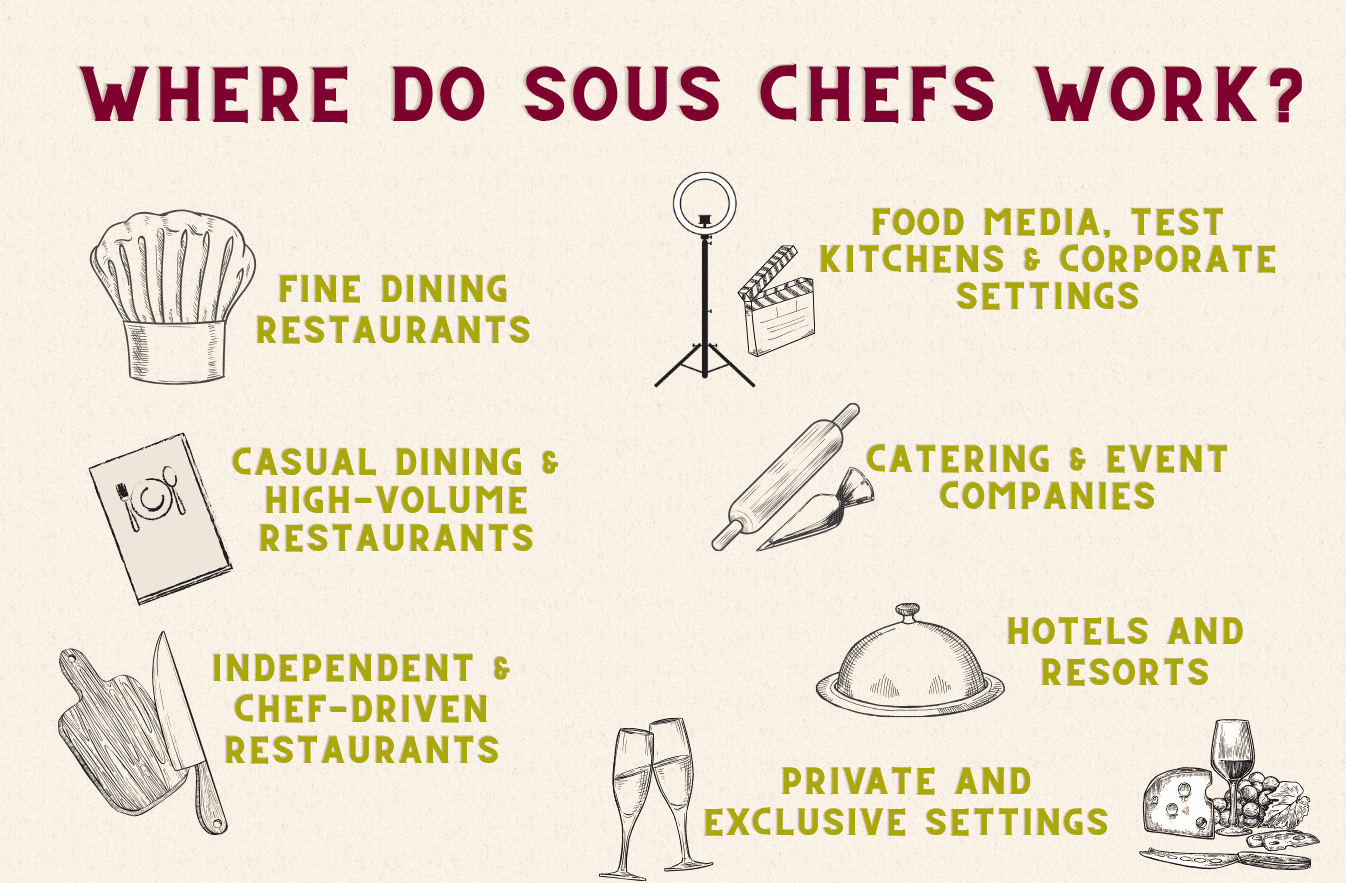
Where Do Sous Chefs Work?
The sous chef role is standard across a wide variety of structured kitchen environments. Among these are:
Fine Dining Restaurants
Fine dining kitchens rest on the philosophy that every plate is a creative statement, and every service is a test. Here, guests, owners and food critics set exceptionally high standards. Those drawn to precision will find few environments as challenging and exhilarating as these.
Casual Dining and High-Volume Restaurants
High-volume kitchens build speed, resilience, and decisiveness. Among the skills required to handle these environments are the ability to hold a standard at scale; to lead a large team through a full front of house service; and to make fast, confident decisions when everything is firing at once. Those aiming to run large culinary operations may find the experience gained here invaluable.
Hotels and Resorts
Imagine overseeing a breakfast service, coordinating a banquet for five hundred guests, and running an à la carte dinner program — all within a single day. Hotel and resort kitchens offer this and more via scale, variety, and logistical complexity. For culinary professionals whose ambitions skew toward international roles or multi-outlet leadership, hotel work can create unique opportunities for growth.
Independent and Chef-Driven Restaurants
In smaller, chef-driven kitchens, working as a sous chef can feel personal in a way that’s harder to find at scale. That’s because creative contributions tend to be more visible and relationships between chef and staff closer. For those who dream of running a kitchen of their own — and having a restaurant that reflects who they are and what they believe about food — independent kitchens can be the start of that dream coming into focus.
Private and Exclusive Settings
Private clubs, luxury estates, and high-profile households can offer sous chefs the opportunity to develop an intimacy with their craft that many larger kitchens rarely allow. Here, you might work with a single client and have a deeply personal relationship with menus and their execution. This path is well-suited to those seeking a high degree of culinary refinement and the challenge of producing extraordinary food in an intimate setting.
Catering and Event Companies
Catering and event kitchens are where high-stakes production meets complex logistics — where the ability to solve problems fast, adapt under pressure, and deliver consistently at scale are vital to success. Sous chefs working in catering and events can gain operational confidence and the versatility needed to pursue an array of professional paths.
Food Media, Test Kitchens and Corporate Settings
Not every sous chef belongs behind a restaurant pass. Food media companies, recipe development studios, culinary institutions, and corporate kitchens offer environments where the skills that define strong kitchen leadership — technique, creative judgment, consistency, the ability to inspire a team — can reach a far wider audience. These careers allow culinarians to inform the way people cook, eat, and think about food.
The degree of foundational training can influence which settings are accessible and how quickly.
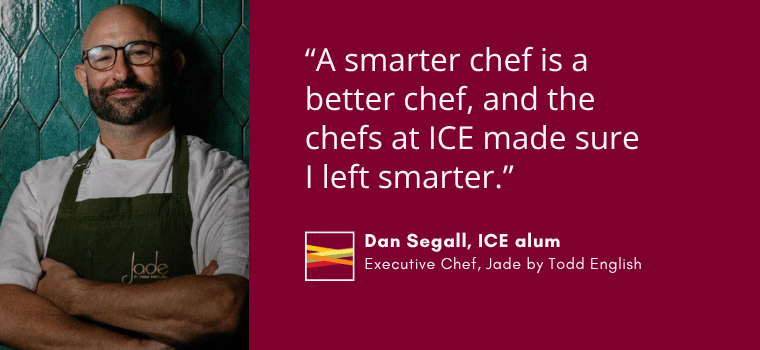
For Chef Dan Segall, who had been cooking professionally for 11 years before enrolling at the Institute of Culinary Education, returning to school for formal training helped expedite his career path. “I would not have progressed so fast if every time a chef asked me for mirepoix, or bechamel, or a chinois, or duxelles, I had to look it up or shyly ask a colleague,” he says.
He also notes that culinary arts education gave him “a working vocabulary and the physical understanding of what those words meant so that [he] could be a useful worker.”
Skills That Are In Demand for a Sous Chef
The sous chef role is where culinary skill and professional leadership converge. The technical foundation has to be there — but so does the ability to lead, communicate, and manage under pressure. Both dimensions matter, and both can be developed with intention.
Technical Skills of a Sous Chef
These skills and responsibilities are fundamental to a kitchen's operations and reputation. A sous chef who takes them seriously is one an executive chef can trust — and trust can open doors to more responsibility and more creative latitude.
- Knife Skills and Classical Technique: The sous chef must be technically credible across the entire kitchen — which means the fundamentals have to be rock solid. Classical knife skills, proper cooking methods, sauce-making, and the ability to work across multiple stations with confidence are the baseline. More importantly, sous chefs must understand why a technique works — and then teach it, troubleshoot it, and adapt it.
- Sauce Work and Flavor Development:Sauces are among the most technically demanding and most visible elements of professional cooking. A sous chef who understands the leading sauces, their derivatives, and the principles of flavor development and balance is equipped to maintain and improve a kitchen's output in ways that station-level experience alone may not provide. Developing these advanced technical skills is often associated with professional advancement in a kitchen environment.
- Protein Cookery:From proper searing and resting techniques to understanding how different proteins respond to different applications of heat, a sous chef needs command over the full range of protein preparations. This is often where the distance between good cooks and great cooks becomes most apparent.
- Global Cuisines and Palate Development:Modern kitchens draw on a range of culinary traditions. A sous chef with broad exposure — to Mediterranean, Asian, Latin American, and Middle Eastern cuisines, among others — brings creative scope and contextual understanding that a narrow technical background may not. Additionally, palate development is a practice that can develop range over time.
Food Safety and Kitchen Management: A sous chef is often responsible for the kitchen's food safety compliance; things like temperature controls, HACCP protocols and sanitation standards. They also source, order and receive food, so understanding ingredient quality — and thus, what to accept and what to return — as well as how to store hundreds of ingredients, is critical.
Soft Skills of a Sous Chef
Technical skills build the foundation. Soft skills are the habits exhibited by future leaders.
- Leadership and People Management: Managing a kitchen team means motivating and mentoring people, correcting poor habits and creating an environment where the team performs better than any one individual. It’s a skill that’s vital to sous chefs, and one that often determines their reputation (because it’s on display every service).
- Communication Under Pressure: Service can be loud, fast and nonstop. The sous chef must, therefore, communicate clearly, calmly and precisely with both the team and the front of house. Staying composed when the stakes are high is a quality that everyone in the kitchen should aim to possess.
- Time Management and Production Planning: The sous chef is often responsible for the kitchen's daily production plan — what gets made, by whom, in what order, and when. This requires organizational aptitude and the ability to anticipate and solve problems before they occur.
- Problem-Solving and Adaptability: A supplier fails to deliver. A cook calls out. A preparation goes sideways an hour before service. The sous chef is the person the kitchen turns to when things go sideways, so the ability to efficiently solve problems is a key skill for sous chefs.
- Culinary Vision and Creative Contribution: Many sous chefs become significant contributors to the creative direction of their kitchens — proposing new dishes, developing seasonal menus, encouraging creativity and contributing ideas that shape the restaurant's identity.
Why Professional Training Can Make a Difference
Sous chef is not an entry-level position. It’s one that cooks work toward, with the quality and scope of their foundation often determining how quickly they arrive to the role.
While it is possible to pursue a sous chef career entirely through on-the-job experience, professional culinary training can help build that foundation more deliberately.
In a busy professional kitchen, the focus is on execution, so there is little time to explain the science behind a technique, to practice a skill until it becomes instinct, or to explore the range of food traditions that inform a rich culinary toolkit. Structured, formal training can fill that gap.
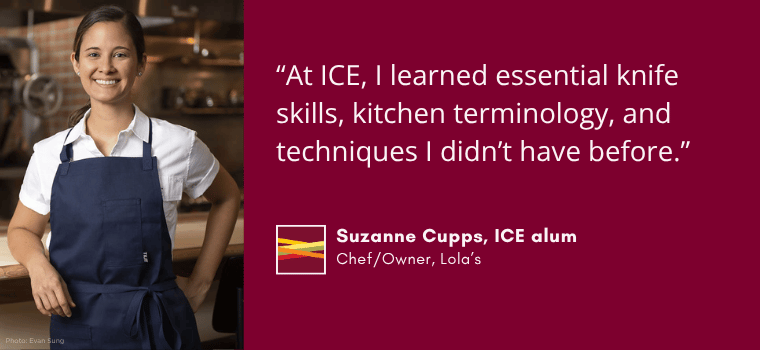
Institute alum and James Beard Award nominated Chef Suzanne Cupps stands as testimony to this. “Before culinary school, I’d never stepped foot in a professional kitchen,” she says.
For her, “the Institute was a great way to practice in a controlled environment and get a full overview of cooking.”
It also, she points out, helped her get her “foot in the door” at places she “wouldn’t have been able to work without any experience.”
In a professional culinary program, students can:
- Develop foundational techniques in a deliberate, sequenced curriculum — including those that professional kitchens do not have time to teach systematically
- Explore the why behind classical methods — building the kind of understanding that allows a cook to troubleshoot, adapt and lead
- Practice under the guidance of Chef-Instructors with real industry experience, who can support the learning process and ensure proper habits develop from the start
- Make mistakes in a supportive environment — before those mistakes happen in a real kitchen during real service
- Develop the professional habits, palate training and contextual knowledge that kitchens look for in future sous chefs
The culinary world is also deeply relational. Access to externships, alumni and industry leaders can be among the most practically valuable aspects of formal training — especially for those who are building their network from the ground up. Those who arrive in a professional kitchen with formal training and a demonstrated investment in their craft can stand out — not just in terms of skills, but as a signal of professional stature.
Institute of Culinary Education Programs That Support a Sous Chef Career
The Culinary Arts program at the Institute of Culinary Education is designed to provide structured, technique-forward training in a professionally equipped environment. The program is available at the Institutes New York City and Los Angeles campuses — and for students who are unable to relocate, an online option is also available.
Training in the Heart of Two Culinary Capitals
Campuses in New York City and Los Angeles place the school’s students in the heart of two culinary capital cities — where the restaurants, people, and conversations that impact American food culture are baked into the environment.
That proximity matters. Students receive hands-on instruction while enjoying campus programming; panels with chefs, entrepreneurs and hospitality professionals; and the dense network of hospitality luminaries that both cities attract.
For Culinary Arts alum Jillian Elliot, building a network was key: “I came to ICE in New York because I didn’t have the connections to pursue the career I wanted. I got those connections plus exceptional training — and that really opened doors for me.”
Russell Hirsch, Pastry & Baking Arts alum of the Institute’s LA campus, seconds this opinion: “The school’s reputation and network within the culinary world is remarkable.”
In New York City, the school’s Manhattan campus features 12 teaching kitchens, a Culinary Technology Lab, a Hydroponic Garden, and a bean-to-bar Chocolate Lab. Its Los Angeles campus boasts three floors of professional facilities, including four culinary arts kitchens, two baking kitchens and a dedicated health-focused kitchen, as well as a research and media library and multiple lecture and event classrooms.
For students who live outside NY and LA and are unable to relocate, the Institute’s online Culinary Arts program delivers the core curriculum and instructor expertise to your home kitchen.
What the Curriculum Covers — and What Takes Time to Develop on the Job
The Institute’s Culinary Arts program is designed to be completed in as little as eight months, with flexible scheduling – including morning, afternoon, evening and weekend classes (the latter in NY only) – available. Its curriculum covers a range of cooking skills. Among them are:
- knife skills and butchery
- classical and contemporary sauce work
- protein cookery; vegetable preparation
- bread and pastry fundamentals
- global cuisines including French, Italian, Mediterranean, Asian, and Latin American flavor systems
- palate development and exposure to an array of ingredients
- plating and presentation and modern culinary techniques.
Students also have access to the Institute’s Wine Essentials series, and Los Angeles students can pursue an Associate Degree in Culinary Arts and Management, combining the diploma curriculum with general education courses and expanded culinary/hospitality-focused business and management training.
The Externship: Where Training Meets the Real World
After completing in-class training, students enter an externship program — working on-site at a real culinary operation alongside industry professionals. This is where the techniques taught in the classroom meet the realities of service, production, and kitchen culture. It’s also where professional relationships can begin to form, launching students toward the next stage of their career.
The Institute’s Career Services team works with students to help identify an externship placement aligned to their skill, goals and background — from fine dining restaurants and private kitchens, to hotels, catering companies and beyond.
Sous Chef vs. Other Kitchen Roles
It’s important to understand where the sous chef fits in the kitchen brigade and what distinguishes it from adjacent roles. Here’s a breakdown:
Sous Chef vs. Chef de Partie
A chef de partie executes a single station, and they are responsible for the quality of its output. A sous chef, on the other hand, is responsible for the whole kitchen — the standards, the team, and the outcome of service. The shift from chef de partie to sous chef is not just a promotion; it is a large step toward exponentially increased responsibility.
Sous Chef vs. Executive Chef
The executive chef sets the vision. The sous chef executes that vision. In many kitchens, the sous chef is the operational heart of the kitchen, while the executive chef is its creative and strategic mind.
Sous Chef vs. Head Chef
In some kitchen structures, head chef and executive chef are distinct roles — the head chef having seniority in day-to-day cooking and the executive chef focusing on broader creative and management responsibilities. In this scenario, the sous chef reports to the head chef, and may have less direct contact with the executive level. In a well-functioning kitchen, the sous chef is not simply a backup for the person above them — they are the keeper of the kitchen’s consistency.
Is a sous chef role the right culinary career goal for you?
High-functioning kitchens require technical excellence and cooperation, and they are staffed by people who revel in elevating the team; creative culinarians who see a busy service not as something to survive, but as something to shape; and ambitious leaders who want to be in the room where standards are set and decisions are made.
Of course, the path to becoming a sous chef isn’t the same for everyone. It is, however, deliberate; it’s in the work done at every station, during every service, day in and day out. The cooks who arrive to the role ready are typically those who took each step toward it seriously.
If these qualities and work ethic ring familiar, the sous chef role may be right for you — and formal culinary training could be the first step on the journey.
Taking the Next Step
If you’re considering a culinary career with a path toward the sous chef role, exploring the Culinary Arts programs at the Institute of Culinary Education may be a useful next step. Admissions representatives are available to discuss your goals, walk you through program options at the New York or Los Angeles campuses, and help you understand the financing and scheduling options available, including online options.
To connect with an admissions representative or request more information, visit ice.edu.
Sous Chef Career FAQs
What is the difference between a sous chef and an executive chef?
The executive chef carries overall responsibility for the kitchen's creative direction, team, and standards. The sous chef is usually the second-in-command — responsible for executing that vision on a daily basis, managing the team during service, and ensuring the kitchen operates to its established standards. In many kitchens, the sous chef is the person most directly involved in day-to-day operations.
What steps lead to the sous chef role?
Most culinary careers progress through the kitchen brigade: commis cook, chef de partie, and in larger kitchens, senior chef de partie or junior sous chef, before reaching the sous chef level. Each stage builds the technical depth, operational experience, and leadership capacity that the sous chef role requires. Professional culinary training can help build the foundational skills that support a more deliberate path through these stages.
Do I need culinary school to work toward a sous chef career?
Formal training is not required, but a structured culinary program can help aspiring sous chefs develop a broader and deeper technical foundation — including many techniques that most kitchens do not have the time to teach systematically — as well as the professional network and externship experience that kitchens at this level tend to value.
How long does it take to work toward a sous chef role?
There is no fixed timeline — the path is shaped by the cook, the kitchen, and the foundation built along the way. Structured culinary training can help build that foundation more deliberately and more broadly, which may support a clearer path toward leadership responsibilities.
What skills does a sous chef need?
A sous chef needs a strong technical foundation across the full range of professional cooking — which includes things like knife skills, sauce mastery, protein cookery and knowledge of global cuisines, among others — plus leadership ability, communication skills, and the capacity to manage a team and an operation under pressure. Both the technical and the leadership dimensions of the role tend to develop in tandem over time.
Where do sous chefs work?
Sous chefs work across a wide range of professional environments including fine dining and casual restaurants, hotels and resorts, private clubs and households, catering companies, corporate dining, food media, and culinary schools. Each setting offers a unique experience, pace, and set of professional growth opportunities.
What is the career path after being a sous chef?
The sous chef role tends to lead toward head chef or executive chef positions — roles that carry full creative and operational responsibility for a kitchen. In larger operations, professionals may advance into roles with intermediate or specialized management responsibilities, including executive sous chef, Chef de Cuisine, or culinary director. The time spent as sous chef is often the time when the habits, relationships and reputation that can make these transitions possible are formed.
Are there online culinary programs that can support a path toward sous chef?
The Institute of Culinary Education offers an online Culinary Arts diploma program designed to deliver foundational culinary training — including technique and business fundamentals — with the flexibility to study from home. The program culminates in an in-person externship at a professional kitchen.